Use the Clusters > Workloads tab to manage workloads in a cluster.
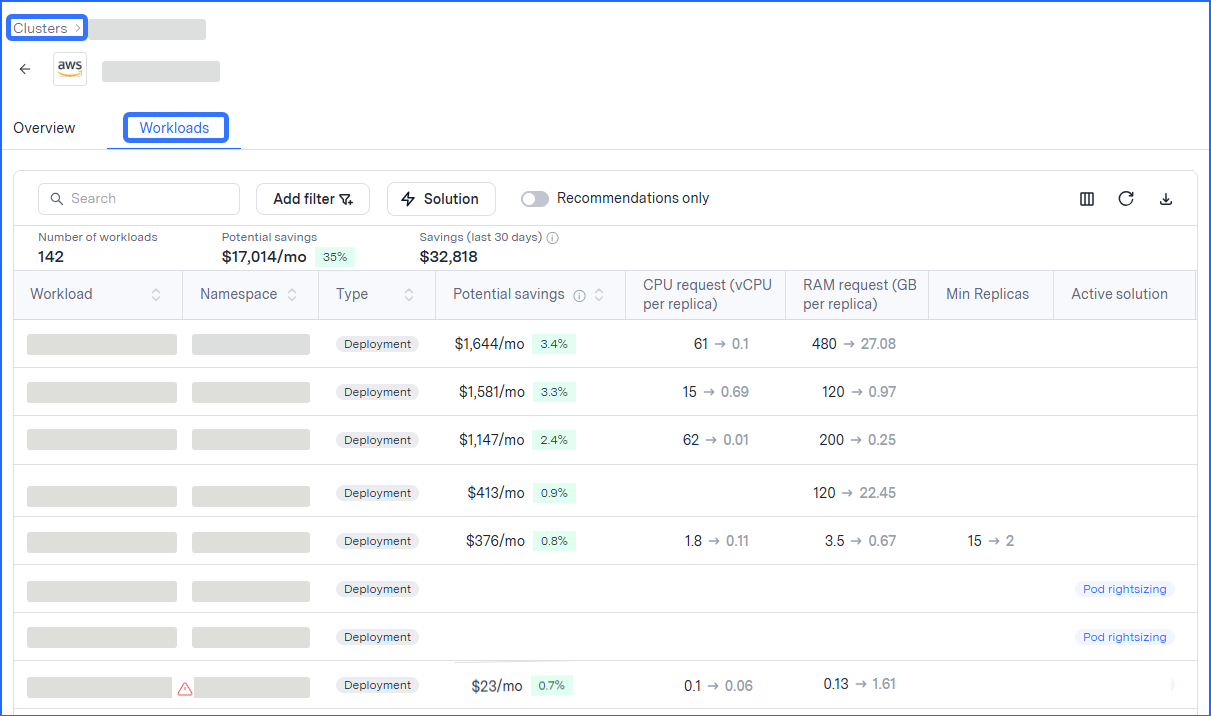
To open the Workloads tab, select the Workloads tab from the Clusters > Overview tab.
(Alternatively, click Optimize from a workload row in the Clusters tab.)
The Workloads tab shows a table with all workloads in the selected cluster, sorted by highest potential savings (by default).
The number and savings data shown above the table reflects all the workloads in the table.
Do you see this banner?
If this banner is shown, Adaptive Pod placement (APP) is not enabled on the cluster. You can reduce cluster costs as shown in the banner - beyond the savings in the table - by enabling APP on the cluster.
For more information, see Enable Adaptive Pod placement.

Use the Workloads tab to do the following:
See potential savings and optimization data.
You can see the following data for every relevant workload - active workloads or those with at least one Pod running in the last 5 days - in the cluster:
Workload general data: The workload name, namespace, and type.
Under-provisioned workload?
If a workload CPU or RAM is under-provisioned,
 is displayed. Hover to see the issue.
Potential savings: The 30-day projected savings after applying Kompass optimization solutions (also expressed as a percentage of the total cost of the last billing cycle)
Potential savings per solution
If you filter this tab for a specific solution, the potential savings reflects savings from that solution only. Potential savings from APP is not included, even when the Solution filter is applied.
CPU request: The current and recommended vCPU request configured for each workload replica, based on Kompass Pod rightsizing recommendation.
RAM request: The current and recommended RAM request configured for each workload replica, based on Kompass Pod rightsizing recommendation.
Min replicas: The current and recommended minimum number of replicas configured for the workload, based on Kompass Headroom reduction recommendation.
You can apply either the Pod rightsizing or Headroom reduction solutions to a workload, but not both at the same time.
Eviction status: The Zesty classification of the workload for Adaptive Pod placement savings. You can use the status to identify which Pods you can reconfigure or restart to accelerate APP savings. For more information, see Adaptive Pod placement.
To view this data, use the column picker to add it to your table.
Evictable: all Pods in the workload can be safely evicted
Unevictable: all Pods in the workload cannot be safely evicted
Hybrid: the workload contains a mix of evictable and unevictable Pods
Unknown: the status of at least one Pod cannot be determined.
Eviction status not showing?
After you activate Adaptive Pod placement in the values.yaml file, it takes one hour for the status to populate. During this time, the status of all workloads displays as Unknown. For more information, see Enable Adaptive Pod placement.
Active solution: The solution that is currently active on the workload.
When a solution is being applied, a clock icon indicates that the operation is in progress. Errors are displayed in red.
The fields above are shown by default. You can use the field picker to add the following workload fields to the table: Cloud provider, CPU utilization, PDB, HPA type. For more information about the field picker, see Additional table activities.
Optimize workloads
To apply an optimization to a workload from the user interface, do this:
Click anywhere in the workload row.
The workload drawer opens where you can apply the optimization.
Select the Pod rightsizing or Headroom reduction tab.
Select a strategy or policy.
Click Apply to workload.
For more information, click Apply and manage Compute solutions with the UI.
To optimize workloads with YAML, see Apply and manage Compute solutions with YAML.
Manage optimized workloads
If a workload has an active solution, you can change the selected strategy or policy or remove the solution from the workload.
To change a currently active optimization from the user interface, click anywhere in the workload row. The workload drawer opens where you can change the optimization. For more information, click Apply and manage Compute solutions with the UI.
To change a currently active optimization with YAML, see Apply and manage Compute solutions with YAML.
Viewing tips for easier workload management
In addition to the standard filter options, use these filtering options to work smarter and faster:
To see this | Filter this way |
|---|---|
All workloads that are either currently optimized by a specific solution OR have optimization recommendations for the specific solution | Click Solution and select the specific solution. The columns related to other solutions are removed. |
Only workloads that can be optimized (the workload has recommendations and no active solutions) | Turn on the Recommendations only toggle. |
Only workloads related to a specific solution that can be optimized (this combines the previous options) | Click Solution and select the solution, and also turn on the Recommendations only toggle. |
Only workloads at risk (under-provisioned) | Click Add filter and select Workloads at risk. |
Only workloads with an active optimization | Click Add filter, then select Status and Active. |
Additional table activities
Show relevant data:
Search by name or add filter criteria.
The data in the table is from the default columns.
To see and select other data columns, click the column picker .
.Sort the table by a column.
Show more rows per table page and change the page shown.
You can export the data in the table.
You can refresh the table.
This is useful when there have been recent changes that are not yet reflected in the table.